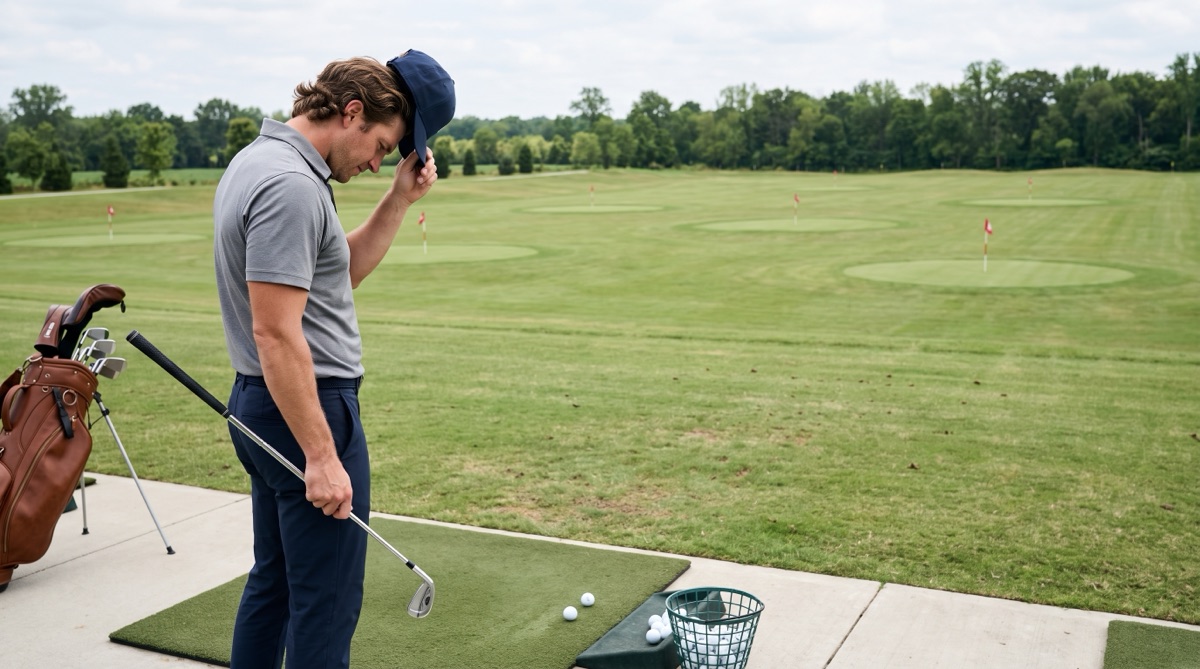
You're putting in the work. You're hitting balls. Maybe you're taking lessons, watching tips, grinding on the range after work. And the scores aren't moving. If anything, golf feels like the one thing in your life where effort and results have quietly stopped lining up.
Here's the uncomfortable truth: effort is almost never the problem. The problem is that most golfers have no reliable way to know what to work on — so they pour all that effort into the wrong places. This is fixable. But the fix isn't "practice harder." It's "practice the right thing," and that starts with seeing your game clearly.
The real reason golfers stop improving
When improvement stalls, the instinct is to blame willpower or talent. Neither is usually the culprit. The missing piece is a feedback loop — a way to see, round after round, where your strokes are actually going.
Two things quietly work against you. First, most golfers practice what they enjoy, not what they need. The range rewards the shots you're already good at, and an hour of crisp 7-irons feels like progress even when it changes nothing about your scores. Second, there's the gap between feel and real: what you think your weakness is and what the numbers say are almost always different. You remember the missed three-footer on 16. You don't remember the approach that left you 35 feet away in the first place.
Decades of research into how people build expertise point to the same conclusion: the single biggest driver of skill improvement isn't the volume of practice — it's the quality of the feedback attached to it. Practice without feedback just grooves whatever you're already doing, mistakes included. So before we talk about what to fix, it's worth understanding how most golfers diagnose themselves — and why they get it wrong.
The 5 most common reasons your game has stalled
1. You're practicing your strengths, not your weaknesses
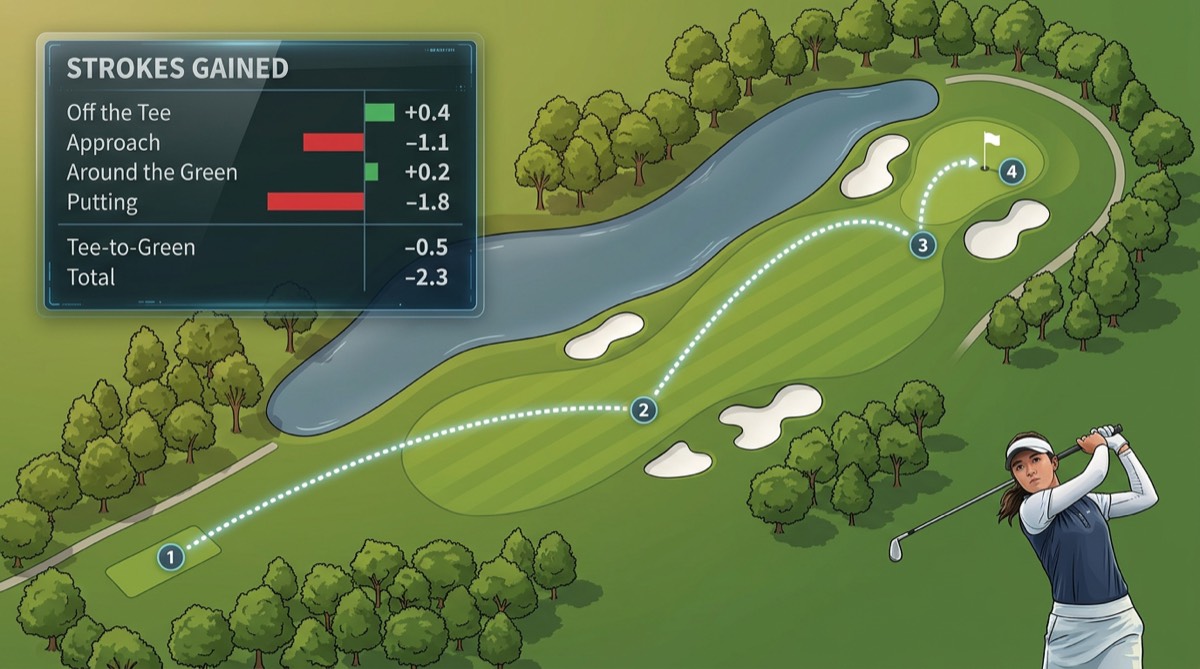
Walk onto any range and watch where the time goes: drivers, then more drivers. It's the most fun club in the bag, and progress feels good. But improvement lives in the uncomfortable shots. For example, if your data showed you were losing 1.8 strokes per round on approach shots from 100–150 yards while you spent 60% of your practice hitting drivers, you'd be making your best area a little better and your worst area a little worse. The fix: find your highest-loss category first, then build your sessions around it.
2. You're misdiagnosing where the strokes are going
The most common self-diagnosis in golf is "I'm a bad putter" — and it's usually wrong. More often, approach play is the real culprit. Consider the math: a tour-level approach from 150 yards finishes, on average, around 23 feet from the hole. Amateurs expect to be closer than that, so when they three-putt from 30 feet they blame the putter — when the real miss was the approach that left them 30 feet away to begin with. The fix: track approach proximity, not just putts per round.
3. Your practice doesn't look anything like your round
Hitting 50 balls in a row at the same target builds range confidence, not course performance. Skills built in "blocked" practice — same shot, same target, same conditions — don't transfer well to the random demands of an actual round, where every shot is a different lie, distance, and decision. The fix: simulate the course. Pick a target, commit to one shot, change clubs, and move on — the way you actually play.
4. You don't have enough data to see patterns
One bad round means nothing. One bad month is a pattern. The trap is reacting to a single round — overhauling your putting after one cold day on the greens — when you're really just looking at normal variance. It typically takes 8–10 tracked rounds before reliable patterns emerge. The fix: track consistently before drawing conclusions.
5. You're working on mechanics when scoring is the real goal
Swing improvement and score improvement are not the same thing. A golfer can have a technically "worse" swing and shoot lower scores by improving course management and decision-making. Chasing a prettier swing is satisfying, but it's not always what's standing between you and a lower number. The fix: treat "swing practice" and "scoring practice" as separate sessions with separate goals.
How data changes everything
Once you can see where the strokes are going, the whole problem changes shape. Imagine you track 10 rounds. Your gut says putting is the issue. The data says putting is actually average — but your approach shots from 75–100 yards are costing you 2.3 strokes per round. That, not putting, is the practice priority. You'd never have found it by feel.
The metric that makes this possible is Strokes Gained, developed by Columbia Business School professor Mark Broadie. It compares every shot you hit to a baseline of how a better player would do from the exact same spot — same distance, same lie — and the difference is the strokes you gained or lost. Aggregate it across a round and "my game feels off" becomes a specific, fixable number.
What to actually track each round:
- Fairways hit (and which club you used)
- Greens in regulation, broken out by distance band: under 75 yards, 75–125, 125–175, and 175+
- Putts per round and putts per green in regulation — these tell very different stories
- Up-and-down percentage from inside 30 yards
How many rounds before patterns emerge: five rounds give you early signals, ten rounds give you reliable patterns, and twenty or more let you set priorities with real confidence. The plateau didn't happen in one round, and you won't see its cause in one round either.
This is where EvoGolf is built differently from most golf apps. Most tools hand you a single round's stats and leave you to interpret them — a snapshot, not a story. EvoGolf is designed for the long game: it tracks your performance round after round so real patterns rise above single-round noise, and it pairs that history with ShotIQ™, a personal AI analyst you can actually ask. "Where am I losing the most strokes?" "Is my putting improving?" "What should I work on this week?" — you get a straight, data-grounded answer, and guidance that adapts as your game changes.
A data-driven practice plan
Here's how to turn the diagnosis into a plan you can run on repeat:
- Track 5 rounds with consistent stats — fairways, GIR by distance, putts, and up-and-downs.
- Identify your single highest-loss category — the one area costing the most strokes per round.
- Build 70% of your next 4 practice sessions around that one category only.
- Play 2 rounds and compare the tracked stats against your starting point.
- Repeat the cycle — find the next highest-loss category and do it again.
To make step 2 easier, here's how common stats map to the real problem and the right practice focus:
| If this stat is poor… | The real problem is often… | Practice focus |
|---|---|---|
| High putts per round | Approach distance, not putting | Track proximity to the hole after approach shots |
| Low GIR from 125–175 yards | Iron consistency at mid-range | Focused iron practice at those exact distances |
| Low fairways hit | Driver accuracy or tee-shot strategy | Fairway wood off the tee; smarter targets |
| Low up-and-down % | Short game from specific lies | Simulate those exact lies in practice |
The mindset shift that unlocks improvement
The hardest part isn't the practice plan — it's resisting the urge to chase the next swing tip. A new grip, a YouTube drill, a different driver: they all promise a quick fix, and they all skip the step that actually matters, which is knowing what's wrong in the first place.
The golfers who break through think in terms of compounding. Improving by half a stroke per round in your worst category is worth more than shaving a tenth off every other area combined. Small, targeted gains stack; scattered effort cancels out. Practice isn't about hitting more balls — it's about building a feedback loop that tells you whether the work is working.
Most golfers don't have a practice problem — they have a diagnosis problem.
Frequently asked questions
If your game has stalled, it's almost certainly not because you aren't trying hard enough. It's because the work isn't aimed at the right target. Find the one area quietly costing you the most strokes, point your practice at it, and let the feedback loop do the rest.
Because every stroke counts.
© 2026 EvoGolf. All rights reserved.