
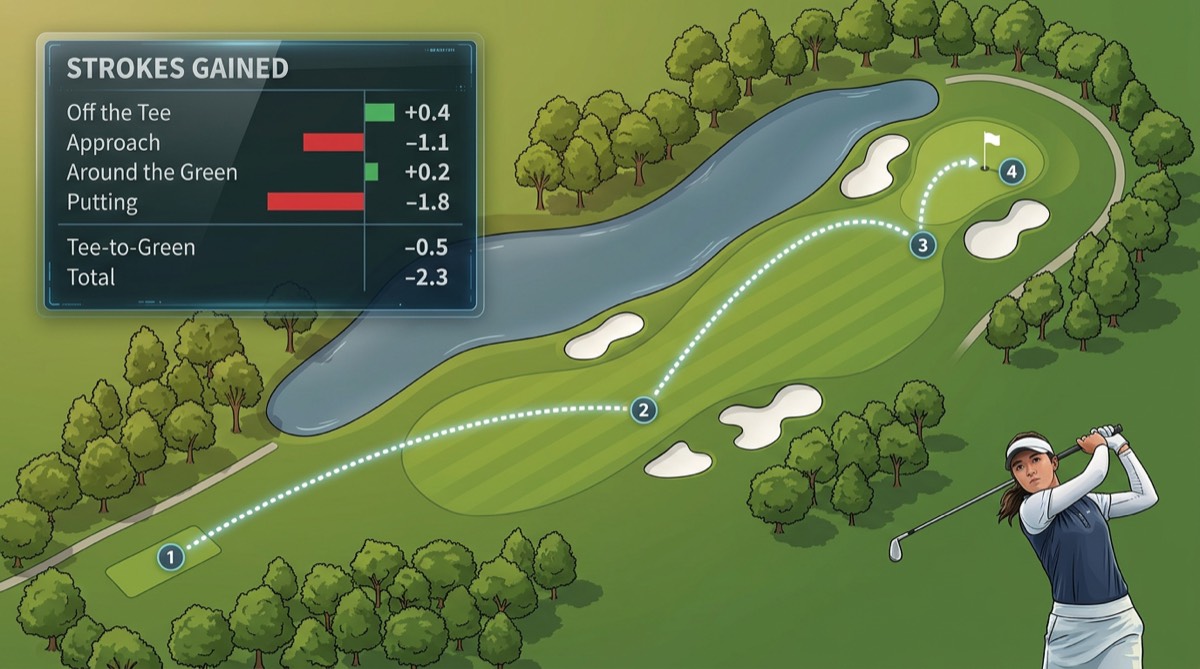
The first time someone said "Strokes Gained" to me at a junior tournament, I nodded like I understood and then went home and didn't understand. I'd seen it on golf broadcasts — a little stat in the corner, "SG: Putting, +2.1" — and filed it under things tour analysts care about and parents don't need to.
I was wrong about that, and it cost my kids time. Strokes Gained isn't a broadcast garnish. It's the most honest answer to the question every golf parent is actually asking: where are the strokes going? And once I finally understood it — really understood it, not nodded-at-a-tournament understood it — I couldn't go back to reading a scorecard the old way.
If the term has floated past you and you've quietly wondered whether it matters for a 13-year-old who's nowhere near the PGA Tour, this one's for you. It matters more for your kid than it does for the pros, and I'll show you why.
1. What Strokes Gained actually measures (plain English)
Here's the whole idea in one sentence: Strokes Gained measures every single shot against what a typical player would do from that exact spot, and tells you whether your junior came out ahead or behind.
Let me make it concrete. Say your daughter has a 15-foot putt. From 15 feet, a benchmark player — a scratch golfer, or a junior at her level, depending on the benchmark you use — takes, on average, about 2.0 strokes to hole out. That's not a guess; it comes from huge piles of recorded shots. If she makes the putt, she took 1 stroke where the benchmark takes 2.0. She gained 1.0 stroke. If she two-putts, she took 2 where the benchmark took 2.0 — she gained nothing, broke even. If she three-putts, she took 3 against 2.0 and lost 1.0 stroke.
Do that for every shot in the round — tee shot, approach, chip, putt — add up all the little gains and losses, and you get a number that says, precisely, how much better or worse than the benchmark your junior played, and exactly which shots created the difference.
That's it. No magic. It's just comparing each shot to "what's normal from here" and keeping score of the difference. The genius isn't the math — it's that it finally measures the quality of the shot, not just whether it landed in a category like "fairway" or "green."
The old stats couldn't do this, and that's the whole reason Strokes Gained exists. "Greens in regulation" gives the same credit to a shot that finishes two feet from the pin and one that finishes forty feet away on the fringe of the green — both count as a green hit, even though one is a near-certain birdie and the other a likely two-putt par. Strokes Gained sees the difference because it measures where the ball actually ended up against the benchmark, not just which bucket it landed in. For a developing junior, that distinction is the entire game.
2. The four Strokes Gained categories
A total number is nice. The breakdown is where it changes how you parent the game. Strokes Gained splits the round into four buckets, and almost every junior is uneven across them.
Off the Tee covers tee shots on par 4s and par 5s — the drives. It measures whether your junior is gaining ground with length and accuracy before the hole really begins, or starting every hole already behind.
Approach covers shots hit toward the green from the fairway or rough — usually the irons and wedges from distance. This is the category that, in my experience, quietly decides more rounds than any other and gets the least attention from parents, who tend to obsess over driving and putting.
Around the Green covers the short game inside roughly 30 yards — chips, pitches, bunker shots, the scrambling that saves a hole after a missed green. It's where a kid either rescues a bad approach or compounds it.
Putting covers everything on the green. It's the most emotional category — missed short putts sting, and parents see them — which is exactly why it gets blamed for rounds it didn't ruin.
Two more numbers you'll see are just these four added up in useful ways. Strokes Gained: Total is all four combined — the single figure for how much better or worse than the benchmark your junior played overall. And Strokes Gained: Tee-to-Green is the three non-putting categories together (off the tee, approach, and around the green), which separates ball-striking from putting. That split is more useful than it sounds, because a hot or cold putter can disguise what the rest of the game actually did. If a junior's Total looks fine but their Tee-to-Green is quietly negative, the putter is bailing out the ball-striking — and the moment the putts stop dropping, the real problem surfaces. That's exactly the kind of thing the breakdown catches and a scorecard never could.
The point of the four buckets is that they don't move together. Your junior can be gaining off the tee and bleeding strokes on approach in the very same round. One number hides that. Four numbers — plus the two roll-ups — expose it.
One thing Strokes Gained is not: a grade. It's tempting to read a negative number as "my kid played badly" and a positive one as "good job," but that misses the point. A total can even come out slightly positive and still hide a real problem — a kid gaining a stroke off the tee may be quietly handing most of it back on approach, and the tidy-looking total never says so. The number isn't a verdict on the player; it's a map of where the strokes went. Read it as "here's what to work on," never as "here's how good you are." That distinction matters more for juniors than for anyone, because a developing kid who hears every report as a report card learns to dread the data — and the whole point is that your junior eventually wants to look at it. Tracking that map across a full season is its own subject, and I covered it in How to Build a Performance Profile for Your Junior Golfer.
3. Why "you putted poorly" and "you lost 1.8 strokes putting" aren't the same statement
This is the part I wish I'd understood three years sooner, so let me sit on it.
"You putted poorly today" is a feeling. It's usually born from one or two memorable misses — the four-footer on 16 that he yanked, the three-putt on 18 that everyone watched. It's vague, it's emotional, and it's frequently wrong, because human memory weights the painful putts and forgets the eight solid ones.
"You lost 1.8 strokes putting" is a measurement. It says: across all 30-some putts today, against what a player your level would have done from those same spots, you came out 1.8 strokes behind. It's specific, it's unemotional, and it can be checked.
And because it's a measurement, it can be acted on. "You putted poorly" gives a coach nothing to do — work on what, exactly? The measured version hands them a specific, checkable target: the 6-to-10-foot range, with a note to leave the short putts alone because those are already gaining strokes. A feeling sparks an argument about whose memory is right; a number ends the argument and points straight at the next drill. That measured-versus-felt gap quietly changes the post-round conversation at home, too — more than I expected — but that family side of it is a whole story of its own, and one I've told separately.
4. What a junior's SG breakdown reveals
Tour pros use Strokes Gained to find tenths of a stroke, because at their level tenths are the whole game. Juniors are different — and this is why it matters more for your kid, not less. Juniors are still developing, which means their leaks aren't tenths. They're whole strokes, sometimes two, hiding in one category, often a single distance band inside that category.
At the tour level, Strokes Gained finds tenths. At the junior level, it finds the whole reason your kid isn't breaking 80.
A typical junior breakdown doesn't read "slightly below average everywhere." It reads "even or better off the tee, even around the green, and losing two full strokes a round on approach shots from 150–175 yards because the ball keeps coming up short." That's not a kid with a bad game. That's a kid with a good game and one specific, fixable hole in it — and the hole is completely invisible on a scorecard, which only ever showed you the 81.
Your kid's particular leak might be approach, or lag putting, or a recovery habit they don't even know they have — but the point is that it's findable, and it's almost never the thing the kid blames walking off the 18th. None of these show up on a scorecard; all of them show up the instant someone measures. The scorecard only ever handed you the 81. Strokes Gained hands you the four shots inside it that actually cost the round.
That's the real story Strokes Gained tells. Not "your junior is good" or "your junior is bad." It tells you that the work you're putting in — and you're putting in a lot — is paying off in three categories and getting eaten alive in one, and it names the one. If you've felt the plateau where scores stop dropping no matter how much your kid practices, this is usually what's underneath it; I wrote about that whole experience in Why Junior Scores Plateau.
5. How to read your kid's first SG report
When you see your junior's first Strokes Gained report, resist the urge to read it as a grade. Read it as a map. Here's the order I'd go in.
Look at the four categories before the total. The total tells you how the round went; the categories tell you why, and the why is the only part you can act on. Find the most negative category first — that's where the strokes are leaking fastest, and it's almost always the highest-value place to spend the next month of practice.
Then look inside that category if the report lets you, because "approach" is too broad to practice. The strokes are usually concentrated in a distance band — a wedge range, a mid-iron range — and that band is the actual target. A good report won't just say "putting"; it'll say "putting, 6–10 feet."
Finally, and this matters: look at it across several rounds before you conclude anything. One round can lie — anyone can have a cold putting day. Three or four rounds tell you whether you've found a genuine weakness or just a bad Tuesday. The pattern is the truth; the single round is just a rumor.
I nodded at "Strokes Gained" for a year before I let it actually change anything. Don't do what I did. It's not a stat for the broadcast — it's the clearest answer you'll get to the question that's been quietly nagging at you every time the scores stall. Where are the strokes going? This is how you finally find out.
Because every stroke counts.
© 2026 EvoGolf. All rights reserved.