I used to take my kids to the course to practice and feel like a good golf parent. I was there for all of it — hitting balls at the range, chipping around the short-game green, rolling putts on the putting green. The whole game, an hour or two of real work, with me in it. That's practice, right? That's the work paying off.
Then one afternoon I looked at what we were actually doing with fresh eyes, and the gap hit me. Nothing about it was lazy, and in the obvious sense nothing was disorganized — we touched every part of the game. But there was no structure underneath any of it. No target distances. No way of telling a good outcome from a bad one. And no connection at all to what their game actually needed on Saturdays. It looked like complete, diligent practice. It was an hour of motion with no aim.
That's the gap I want to talk about. Almost every junior practices, and most of them work hard and cover everything. Far fewer practice in a way that actually drops their scores — and the difference isn't effort, or even spreading that effort across the whole game. It's aim: targets, outcomes, and a line connecting each rep to the leak that's really costing strokes.
1. The "just hit balls" problem
"Just hitting balls" is the default state of junior practice, and it's seductive for reasons that have nothing to do with improvement.
It feels productive — there's visible effort, a pile of balls, a tired kid who touched every station. And it gets measured in the wrong currency: we count balls hit, minutes spent, and stations covered, because those are easy to see and skill built is not. A kid can hit the range, the chipping green, and the putting green, check every box, and still finish an hour that moved nothing.
The reason is that golf doesn't reward time served, or even effort spread evenly across the bag — it rewards specific capacities, built deliberately. Hitting fifty wedges at no particular target, or rolling putts from wherever the last one happened to stop, grooves almost nothing: there's no distance to dial in, no outcome to chase, no feedback that says better or worse. The session generates motion and fatigue, not skill.
And here's the deepest cost. Aimless practice doesn't just build less — it's impossible to evaluate. Ask the only question that matters — is my kid actually getting better? — and there's no answer, because nothing was measured. Even when the scores drop, you can't credit the practice, because scores move for reasons that have nothing to do with it: an easier course, a hot putter, a kid who's simply growing. So the routine runs on faith. How would anyone ever know whether it's working? They wouldn't. That's the real gap between "they practice a lot" and "they're getting better" — and the bridge across it isn't more effort. It's a plan — and a plan worth anything has to be built on real data about where your junior is actually losing strokes, not on a hunch about it. Everything else here is just how you build that plan and prove it's working.
2. What purposeful practice actually means
Purposeful practice is just practice with a target and a way to know if you hit it. That's the whole definition. But it's worth pulling apart, because each piece is something aimless practice is missing.
It has a specific target — not "get better at golf," not even "work on putting," but "make more putts from 6 to 10 feet," a defined skill you can actually train. It has a way to measure whether the target's being hit, so you know if the session worked instead of just guessing. It's uncomfortable on purpose, leaning into the weakness rather than rehearsing the strength, which is exactly why it doesn't feel as good as beating drivers. And it includes feedback — make the putt or don't, land it in the zone or don't — so every rep teaches something instead of just adding to a count.
One clarification, because it trips people up: purposeful doesn't mean robotic, and it doesn't mean grinding the identical shot a hundred times in a row. Varying the shots — different clubs, distances, and lies, rep to rep — is some of the most valuable practice there is, precisely because a round of golf is relentlessly random; your junior almost never hits the same shot twice. (Good course management imposes a little order on that chaos, but that's a story for another post.) So random, varied practice isn't the enemy — aimless practice is. The test is whether each of those varied shots still has a target and a knowable outcome — did it finish where they intended, yes or no — or whether they're just balls going somewhere.
The reason this matters so much for juniors specifically is that they have limited practice time — school, other sports, the simple fact of being a kid — and every aimless hour is an hour that didn't move the score. Purpose is how you get a real return on the limited time you've got, instead of confusing motion for progress.
3. How performance data ranks the leaks
Everything so far assumes you know which leak to aim at — and that's where most families are flying blind, aiming by gut and last week's most memorable miss. Pinpointing the real leak is a measurement problem, one I take on in its own right elsewhere. But for practice specifically, finding the leak isn't even the hard part. Ranking the leaks is.
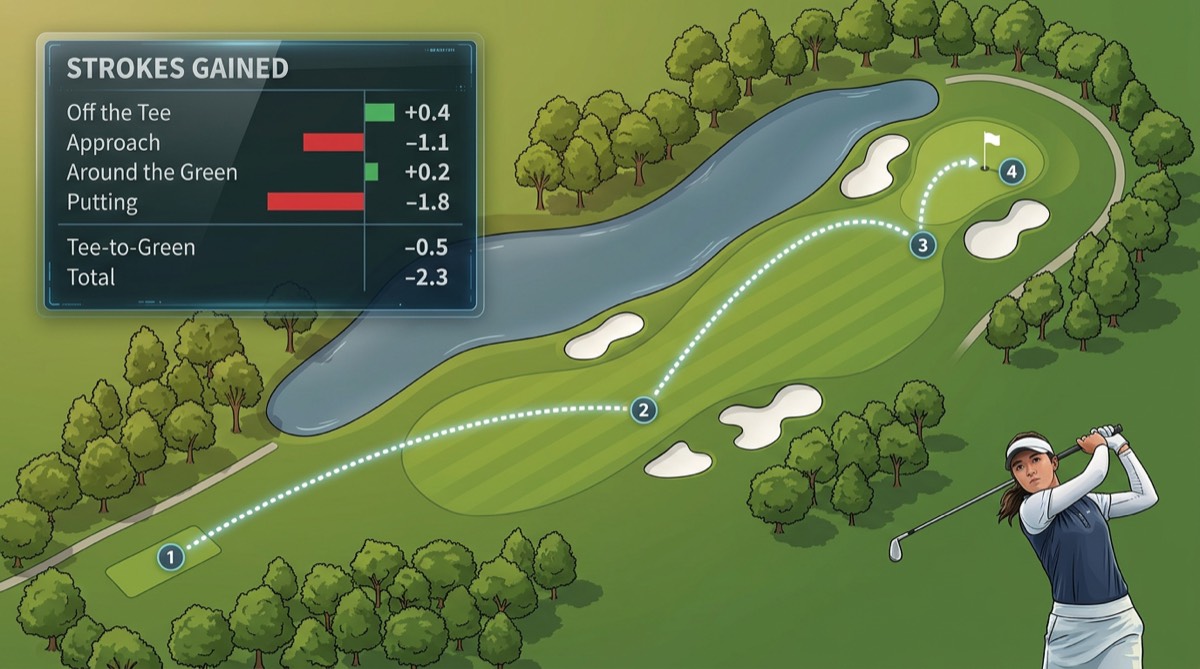
This is exactly where performance data earns its keep. Strokes Gained and category data don't just tell you a category is weak — they rank the leaks by how many strokes each one is actually costing, which is the part guesswork can never do. I went deep on how Strokes Gained works in Strokes Gained for Junior Golfers, but the practice payoff is simple: it sorts your junior's weaknesses from most expensive to least, so you spend the limited practice hours on the leak that's bleeding the most strokes first.
Aimless practice treats every weakness as equal. Ranked practice attacks the one actually costing the most — first.
That ranking flips practice from reactive to strategic. Instead of working on whatever the last bad shot was, or whatever feels fun, your junior works on what the data says is costing the most — and works down the list in order of impact. It's the difference between bailing water randomly and finding the actual hole in the boat. The same hour of effort, pointed at the single most expensive problem, is worth several hours sprayed across problems that barely matter.
Ranking also protects you from the most common practice mistake: trying to fix everything at once. A kid who's told they need to work on putting and wedges and driving will spread a single hour thin across all three and move none of them. The ranking overrides that instinct — pour the hour into the one most expensive leak until the number actually moves, then go to the next. Focus beats breadth, and the ranking is what tells you where to point it.
4. A practice session built from data (worked example)
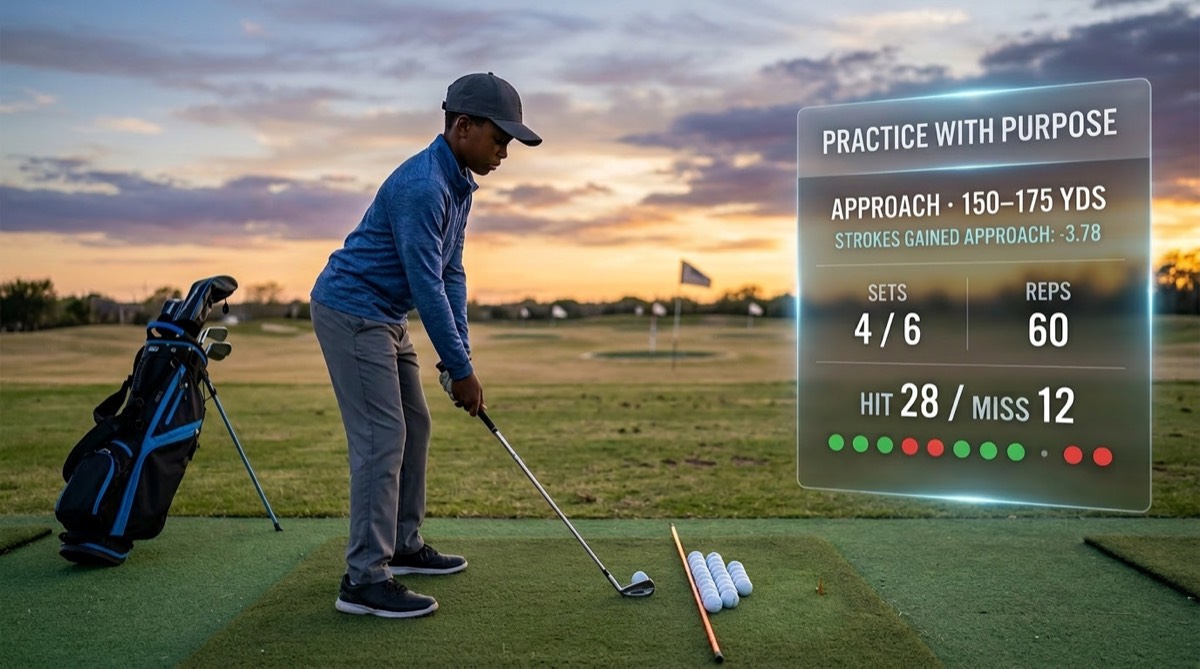
Let me make it concrete with a real-shaped example. Say the data shows a junior losing about 1.8 strokes a round on the greens, with almost all of it concentrated from 6 to 10 feet — making far fewer of those than a player at their level should. That's the most expensive leak on the list. So we build the session around it instead of around the bucket of drivers.
A purposeful 45-minute block might look like this. Ten minutes of warm-up putts to get a feel for the green's speed — not aimless, just calibrating. Then the core: twenty-five minutes on a 6-to-10-foot drill with a measurable target — a tee gauntlet at eight feet, putting until they make seven in a row, or counting makes out of twenty and writing the number down so next week has something to beat. Then ten minutes of pressure simulation, where a miss means starting the count over, because the 6-foot putt that matters always comes with a little fear attached and practicing it calm doesn't transfer.
Notice what's not in that session: a little of everything. There's no drifting from the range to the chipping green to the putting green giving each a vague ten minutes — the whole block points at the one leak costing the most. Notice that there's a number at the end — makes out of twenty — so we'll actually know whether the session worked. And notice it's uncomfortable, by design. That's not a flaw in the plan. That's the plan working.
5. Practice rhythm: data → drill → re-measure
One good session is nice. The real gains come from a rhythm, and it's a simple three-beat loop.
Data identifies the most expensive leak. Drill attacks that specific leak with purposeful, measured reps over a stretch of sessions. Then you re-measure — back in real rounds, does the data show the leak shrinking? If yes, the drill worked; move down the list to the next-most-expensive leak and start the loop again. If no, the drill was wrong for this kid, and you change the approach before wasting another month. Then repeat, forever.
The re-measure step is the one almost everyone skips, and it's the most important. Without it, you never actually know if the work worked — you just assume it did because your kid put in the time, which is the exact assumption that got everyone stuck in the first place. Re-measuring in real rounds is what closes the loop and keeps you honest: it either confirms the leak is shrinking and you move on, or it tells you the drill missed and you adjust before burning another month. Effort you can't measure is just effort you have to take on faith, and faith is what aimless practice runs on.
That loop is the entire engine of improvement, and it's also the antidote to the plateau so many junior golfers hit — the wall where scores stall no matter how much the kid practices. The plateau usually isn't a talent ceiling; it's an aim problem, the same leak going unaddressed round after round because nobody could see it clearly enough to attack it. I wrote about that whole experience in Why Junior Scores Plateau. The data → drill → re-measure loop is how you break it: you stop practicing in general and start closing specific, measured gaps one at a time.
I think about that afternoon a lot — a kid working through every part of the game and getting better at none of it, an hour of real effort aimed at nothing. My kid wasn't lazy. They were unaimed. The work was there; the target wasn't. You're already getting your junior to the range, already paying for the bucket, already investing the time. The thing worth adding costs nothing extra: knowing which leak that hour should attack, and being willing to make it a little uncomfortable. Effort was never your family's problem. Aim is the multiplier.
Because every stroke counts.
© 2026 EvoGolf. All rights reserved.