
Spend enough years at junior golf tournaments — local, regional, state, national championships, including invitationals — and you start to recognize the players and maybe even get to know their games. You see them tournament after tournament, year after year. And you notice something universal: at some point, almost every junior golfer hits a wall.
The grind of junior golf is real, and the plateau is not a flaw. It's just where the road bends for almost every kid. When it happened to my two juniors, I thought it was a coaching problem — so we switched coaches. Then I wondered if it was confidence — so we added tournaments. After one tournament in particular and seeing some weird variances in distance and ball flight, I thought it could be the equipment, so we got fitted and bought new clubs based on what the data showed. Each time, scores would improve, but over time we might see a stall again.
None of those decisions came cheap. Junior golf — between coaching, tournaments, equipment, and travel — is an estimated $3–4 billion market. It's a real commitment for any family. And the most expensive part isn't the bill at the end of the season. It's the time we don't get back when our best guesses don't quite work. A season in junior golf is short. Every guess that doesn't move the needle is one your kid doesn't get to spend on the thing that would have.
That's the part that's hard about the plateau. Not that it happens — it happens to every junior — but that breaking it takes the right information at the right time. That's what this post is about. And it's why I built EvoGolf in the first place.
If you're reading this, you probably know the curve I'm talking about. The first two years are real, visible improvement. You might see fewer double bogeys, three-putts, and penalties, and more pars and birdies. Scores start dropping, sometimes in spurts. Then you might start seeing some Top 10 then Top 5 finishes, before consistency develops and the kid starts winning local junior events. But as pressure and expectations build — self-imposed or otherwise — the curve flattens. The lessons keep happening. The range time keeps happening. The tournaments keep happening. But either the scores stop improving, or they start to go the other way.
This is the post I wish someone had handed me ten years ago. Not because the plateau is unique to your kid — it isn't — but because almost everything I tried at first was a guess, and the guesses cost us a season.
1. The plateau isn't random
Here's the first thing I had to learn: when a junior's improvement stalls, it isn't because they stopped trying or stopped having talent. It's because something specific is costing them strokes — and you cannot see what it is from leaderboards or typical scorecards.
A typical course scorecard tells you what happened. It does not tell you why. Your kid shot 82. You know they had three doubles and a triple. You know the back nine was worse than the front. Maybe you even know Fairways Hit percentage, Greens in Regulation, or total putts — but that's it.
And even when your junior has their own explanation for the round, the explanation might not give us the full picture of what's going on. Over the years my kids would walk off the course and tell me exactly what they needed to work on. Putting would often come up, because they remembered the three-footer they missed on 14. But that three-putt: was their putting really what failed them, or was it the statistically challenging approach shot that left them thirty-five feet out instead of twelve? Or was it the poorly positioned tee shot that led to the tough approach in the first place? Without measuring where the strokes are actually being lost, even the player who hit the shots can be guessing about why.
But this isn't just a measurement problem — depending on how involved a parent can be, it could also become a relationship one too. The gap between how the player sees the round and how the parent might see it became a real source of conflict in our house, and over time, a slow degradation of trust. If I think one part of the round cost us and my kid thinks another, neither of us is wrong exactly — but we're not solving the same problem either. Without something objective to point at, the dreaded post-round conversation — also famously known amongst many juniors as "the car talk" — becomes about whose interpretation is right, not what actually happened.
The plateau is what happens when the cost of those hidden strokes stays constant. Every round, your junior is leaking the same kind of strokes in the same kind of situations. They don't know it. Their coach probably doesn't know the exact magnitude of it. You definitely don't know it. So nobody is practicing it. And the scores stay where they are.
Every golfer makes mistakes — even tour pros. Improving golfers stop making the same ones. Plateaued golfers can't see which ones to stop making.
2. What "more practice" actually buys you
The default response when a junior plateaus is more reps. More lessons. More range time. More tournaments. The logic feels right — practice harder, score better. And for the first two years, it actually worked. So when it stops working, the instinct is to do more of it.
Here's what I've come to believe after measuring it: more practice without a target doesn't actually move the score. When it looks like it's working — early in a season, in the first couple of years — what we're really seeing is natural development. The range time isn't doing the work. Without a measurement of where strokes are being lost, every range session is the same range session. Your kid hits the same clubs, from the same lie, at the same flat targets, with the same intention. The session reinforces what they're already good at and never touches what's actually costing them strokes.
And there's a reason this happens. Players naturally default to practicing what they're already good at, because progress feels good. Fifty 7-irons that all land in the same spot feels productive. The same hour spent on awkward 165-yard approach shots, missing most of them, doesn't feel productive in the moment. But the second session is the one that breaks the plateau.
I'm not arguing against practice. I'm arguing against random practice. There's a version of range time that breaks plateaus, and there's a version that doesn't, and they look identical to the parent watching from the parking lot.
More practice without a target reinforces what your kid is already good at. It rarely touches what's costing them strokes.
3. The three most common hidden strokes
After watching a lot of junior rounds get analyzed at the per-shot level, the same three patterns tend to show up. Not all of them, and not all in the same kid — but they're common enough that it's worth checking whether any apply to yours.
Mid-range approach shots (140–170 yards). The single most under-discussed leak in junior golf. The kid hits the par-3 well. They hit the wedge well. They're learning to drive the ball. But the mid-range approach — the shot that decides whether they're putting for birdie or chipping for bogey — is often a coin flip. Half the time the ball ends up 30 feet from the pin, half the time in the wrong fairway. Most parents don't know how much that 30-foot result costs over 18 holes, because they don't measure it.
Lag putting from 25+ feet. If your kid three-putts twice a round, it's almost always the first putt — not the second. The first putt is too short or too long, and the comeback becomes the visible miss. Coaches address the comeback because that's the one parents notice. The first putt is the actual problem, and the lag stroke is rarely what your kid is practicing on Sunday afternoon.
The recovery decision. When your kid is in trouble — behind a tree, in the rough, short-sided — they take the aggressive shot more often than the percentages support. Each decision is small. Across a round, the cost stacks. This one isn't a swing problem. It's a course-management problem dressed as a swing problem.
None of these show up on a scorecard. All three of them show up the second someone measures.
4. How a diagnostic round reveals them
This is where the rest of the conversation has to shift, because the question is not "is there a hidden leak?" — there usually is — but "how do you find the specific one your kid is leaking?"
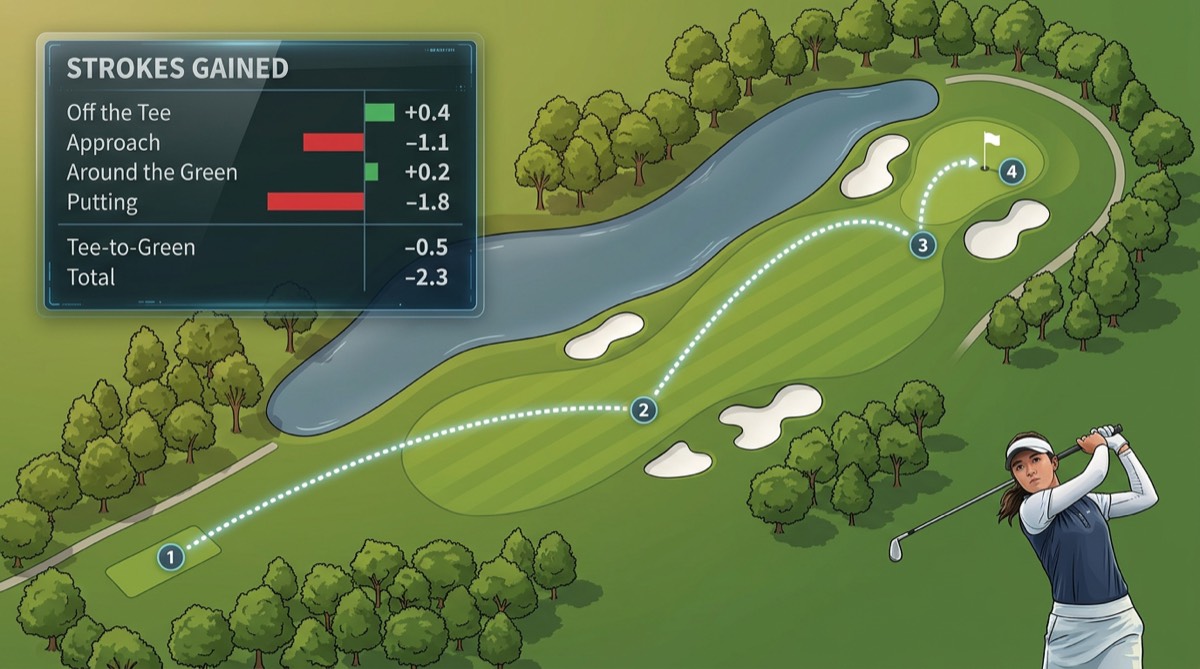
The answer is the metric tour pros use to rank themselves: Strokes Gained. Plain English, it compares every shot your junior takes to a baseline of how a scratch player would have done from the exact same spot. The starting yardage, the lie, the distance to the pin — all of it. The difference between your junior's result and the baseline is the strokes gained or lost on that shot.
Aggregate that across a round and you don't get "your putting was off." You get something like: "1.8 strokes lost from 6–10 feet across the last five rounds, while gaining 0.4 strokes from inside 6 feet." Now you know. Not in a vague way. Specifically.
This is what a diagnostic round is. It's not a different kind of round. It's a regular round, played with the data captured per shot, then analyzed against the baseline. After the round, instead of "you shot 82," you get a profile that tells you which four shots, out of 82, are responsible for half the strokes lost.
The other half of the answer is volume. One round is a snapshot. Five rounds is a pattern. Twenty rounds is a profile you can actually trust. The plateau didn't happen in a single round, and you won't see the cause in a single round either. But by five, the leaks become obvious.
5. What to do once you know
Knowing where the strokes are going changes everything about what comes next. The "what to fix first" question stops being a guess. Two things become obvious:
Practice gets a target — and so does coaching. If the diagnostic says your junior is losing 1.8 strokes per round on mid-range approach shots, you don't go to the range and hit 50 wedges. You hit 30 shots from 145 yards to a green-sized target. Same hour, different result. And the lesson with your coach stops being a generic swing tune-up — it becomes a targeted intervention on a specific shot pattern. Most coaches will tell you they've wanted this data for years.
Tournament selection gets sharper. If the leak is mid-range approaches, a tournament on a 6,300-yard course with elevated greens makes it worse. If it's lag putting, a course with massive Bentgrass greens is the wrong test this month. The diagnostic doesn't just tell you what to practice — it tells you what conditions actually develop the part of the game that needs developing.
6. The plateau is breakable. The wait isn't.
For me, the hardest part of watching a junior plateau was the temptation to wait it out. Sometimes the wait works and the plateau breaks on its own — but sometimes the wait is a full season of practice on the wrong things, and seasons in junior golf are not interchangeable. Twelve is not the same as thirteen. Fifteen is not the same as sixteen.
The faster route is the diagnostic. Five rounds, captured at the per-shot level, analyzed against baseline. You'll see the leaks. Your coach will see them. And your junior — the part that surprised me most — will start to see them too, because the data is concrete in a way that "you need to work on your putting" never is. Data doesn't fix everything. Practice still has to happen. Confidence still matters. But you'll spend all of those on the right things, which is the difference between a season that broke the plateau and one that didn't.
Because every stroke counts.
© 2026 EvoGolf. All rights reserved.