
I kept every scorecard from my older junior's first two competitive seasons. A shoebox of them, then a spreadsheet, then a folder on my laptop. And one night, sorting through them, I realized something uncomfortable: I had two years of scores and almost no idea why any of them happened.
A 79 and an 86 sat side by side from the same month. I could tell you which was better; I couldn't tell you what was different. Three-putts? A blow-up hole? Wedges that wouldn't hold the green? The scorecard had the result and none of the reasons. It's a receipt, not a story.
If you've been saving scorecards too, hoping they'd eventually add up to a picture of your kid's game, I want to save you the two years I lost. The picture exists — but it lives one layer underneath the number. That layer is a performance profile, and once you see your junior's game through it, the scorecard starts to look almost quaint.
1. What a "performance profile" actually means (vs. a scorecard)
A scorecard answers one question: how many strokes did it take? A performance profile answers a different one: where did those strokes come from, and is that pattern getting better or worse over time?
Think of how a doctor reads a patient. Your weight on the scale is a number — useful, but it doesn't say what's happening inside. Blood pressure, bloodwork, trends across visits: that's the profile. It's the difference between "you're heavier than last year" and "here's the specific thing to fix, and whether what you tried is working."
For a junior golfer, the profile turns a season of disconnected numbers into a continuous story. Instead of she shot 82, you get she's gaining a stroke a round off the tee since last spring, steady on approach, still losing her round inside 10 feet. Same kid, same season — but now you can see her, not just her score.
The scorecard isn't wrong — it just stops talking the moment the round ends. A profile keeps the conversation going, round after round.
2. Depth, at three zoom levels
A profile's whole value is depth — understanding your junior's game, not just recording its score. Under the hood it runs on Strokes Gained, the per-shot metric I break down in Strokes Gained for Junior Golfers; what turns that raw data into understanding is reading it as a full SWOT — strengths, weaknesses, opportunities, and threats, the four-quadrant read a business uses on itself, pointed at a golfer. Strengths and weaknesses are the obvious pair — what your junior does well, and where they're losing strokes now. The other two are where it gets interesting. Opportunities aren't just any weakness; they're the highest-leverage one — where the most strokes are sitting there to be gained, the fix that would drop the score the most. And threats are the sneaky quadrant: a strength that's quietly slipping — often because the kid feels so good about it they've stopped practicing it — or a score propped up by something that won't last. A round saved by draining four 10-to-15-foot par putts looks fine on the card, but that's a threat, not a strength — it papered over a real problem and won't hold up next week.
And it runs that SWOT at three levels of zoom, because a game looks like a different thing depending on how far back you stand.
Each round. A SWOT on the single round just played — what your junior did well, where the strokes leaked, the openings they left unused, the patterns that could bite them next time. The close-up: one round, fully understood, the night you post the card.
Each event. A multi-round SWOT across a whole tournament — what held up over 36 or 54 holes and what cracked as fatigue and pressure stacked. A single round can't show that a kid is sharp on day one and gives back two strokes a round by day three; the event view can.
Every 10 rounds. A rolling observation across the last ten rounds — and here's the important part: it reads the pattern, not an average. Collapsing ten rounds into one number is its own kind of lie; it can look "fine" while the game is actually sliding, or hide a strength and a weakness that cancel out on paper. The 10-round view watches the shape instead — is approach play climbing since spring or slipping? is a good week a real gain or a hot putter that'll cool off? — and adjusts for the courses actually played, so a 78 into the wind isn't read the same as a 78 on a calm Tuesday. The pattern is the truth; an average would bury it.
You'll notice none of this requires your junior to play better to become visible. The strengths, the leaks, the slope were all there in every round they've already played — the rounds just weren't read deeply enough for anyone to see them. A performance profile doesn't add a thing to your kid's game. It lets you finally understand the game they already have.
3. Why tournament results alone aren't enough
Here's the trap I fell into, and I think most parents do: tournament finishes feel like the truth because they're public, ranked, and emotional. Your kid either made the cut or didn't. Top 10 or top 40. It's concrete, so it feels like signal.
But a finish is a blend of your junior's game, the field's game, the course setup, and a fair amount of luck, all mashed into one number you can't unmix. A T-15 can hide a kid who's developing beautifully and ran into a stacked field. A win can hide a kid whose putter got hot for three days over a real, persistent ball-striking problem that's going to resurface the moment the putts stop dropping.
I watched this happen in our own house. My junior finished a regional event better than ever — but the underlying numbers were worse than the month before; the putter bailed her out. Three weeks later, on tougher greens, the putter went cold, the ball-striking problem we'd never addressed surfaced, and a good week became a missed cut. The finish told me to celebrate. The profile would have told me to get to work.
Results tell you what happened in that field, that week. Development is a longer, quieter thing that lives in the layers underneath. Watch only the leaderboard and you're reading the last page of every book, guessing the plot.
4. What this looks like in practice (specific example)
Let me make this concrete with a composite of a junior I'd describe as typical — a 14-year-old shooting in the high 70s to mid 80s, ten tournament rounds in.
A finish tells you what happened in that field, that week. A profile tells you who your junior is becoming.
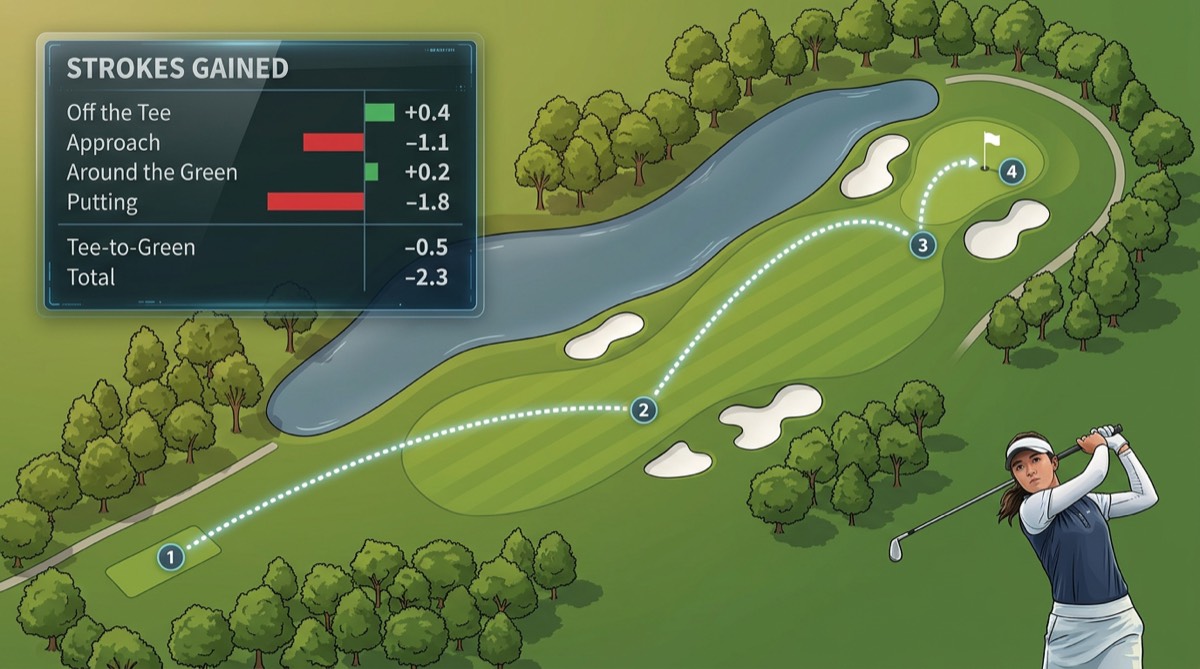
Off the tee, he's gaining about +0.4 strokes a round versus his level — a real strength, and notably, it's been climbing since he got fitted for a driver that actually matched his swing speed. Approach play is roughly neutral, with one ugly pocket: from 140–170 yards, the mid-range approach that decides whether he's putting for birdie or scrambling for bogey, he's losing close to a stroke a round, usually short and in front of the green. Around the green he's slightly positive. And on the greens he's losing about 1.8 strokes a round, almost all of it from 6 to 10 feet, where he's making far fewer than a player his level should. And because those figures are adjusted for the courses he actually played — not flattered by easy setups or punished by hard ones — you know the approach leak is real, not just a couple of brutal weeks.
Now look at what that profile does. It tells the coach exactly two things to work on — the 140–170 mid-range approach and the 6-to-10-foot putt — and to leave the driver alone, because it's already trending the right way. It tells the parent to stop saying "you've got to make more putts" (useless) and to see that the round isn't falling apart everywhere — it's falling apart in two specific, fixable places. And it gives all three — kid, coach, parent — the same map to work from, instead of three different hunches and a debate over which one's right.
And the data does one more thing I didn't expect, and in my house it mattered as much as any stroke: it ends the arguments. The read comes from the numbers, not from mom or dad — and numbers don't take sides. The conversation turns honest, and instead of parent-versus-kid, you end up on the same side of the problem, working it together.
That's the whole promise. You're already putting in the work — the lessons, the range time, the entry fees. A performance profile tells you why the game isn't improving where it isn't, and exactly what to fix next. Not "try harder." This shot, this distance, this gap.
5. How to start building yours
Here's the honest truth about getting started: a regular scorecard, no matter how diligently you fill it in, will never capture what a real performance profile needs. You can eyeball your last few cards and tally fairways, greens, and putts, and you'll catch rough tendencies — almost every junior has one or two categories doing most of the damage. But that's the ceiling. "Fairway hit, green missed, two putts" tells you a shot missed; it can't tell you the one thing Strokes Gained actually runs on — where every shot started and where it ended up.
Computing true Strokes Gained needs per-shot detail — the start distance, the lie, and the result of every shot, measured against a benchmark. No paper scorecard holds that, and doing the math by hand isn't realistic — I know, because I did it for a while, building Strokes Gained spreadsheets late at night after a five-hour round and the long drive home, hours I didn't have. That's the gap EvoGolf closes, and there are two ways to capture it: the mobile app, where a parent acting as caddie or observer logs each shot as the round happens, or the EvoGolf custom scorecard, built to record the shot-level detail an ordinary card throws away. Either way, the round becomes a full profile in under five minutes — the hours I used to spend, gone — and you stop staring at a final number and start watching the trend underneath it move over time.
One more thing I'd tell my younger self: start now, even if the profile is thin at first. A single round is almost useless on its own — a handful start to show a pattern, and a full season gives you a picture you can lean on. The profile only gets more honest the longer you keep it, which means the most valuable version is the one you began two years ago. The second-most valuable is the one you start this weekend.
Two years of scorecards taught me the score and nothing else. The first month of a real profile taught me more about my daughter's game than the shoebox ever did. The work you're already putting in deserves to be seen — and a final number, however good or bad, was never going to show it to you.
Because every stroke counts.
© 2026 EvoGolf. All rights reserved.