A few years into my older junior's tournament golf, I went looking for a scorecard that could actually tell me what happened in a round. Not the score — I had the score. I wanted to know why the score was the score. Which shots cost us, where the round actually turned, what was worth working on Monday morning.
I couldn't find one. Every scorecard I could buy or download had the same handful of boxes: hole, par, total strokes, maybe putts, maybe a fairways-and-greens checkbox. None of it could answer my question, because none of it recorded the one thing analysis depends on — where each shot started and where it ended up.
I tried the workarounds first. The cards that advertised "stat tracking" tracked the same three things — fairways, greens, putts — just in a nicer font. The apps either wanted the player tapping a phone between shots, which no kid in contention is going to do, or asked for so much input that nobody kept it up past the third hole. What I actually wanted — the full shot chain, captured fast enough to use during a live round — didn't exist.
So I built my own. What follows is what's on it and why each piece is there — because a scorecard that captures the real round is the difference between guessing about your junior's game and finally seeing it.
1. Why a standard scorecard can't tell you anything
A traditional scorecard is a tally sheet. It was designed to do one job — total the strokes and settle who won — and it does that job fine. But totaling strokes and understanding them are different tasks, and the standard card has a box for the number of shots and nowhere for the shots themselves.
Think about what a "5" on a par 4 actually hides. It could be a perfect drive, a blocked approach into a bunker, a good sand shot, and two putts. Or it could be a drive into the trees, a punch-out, a brilliant wedge to four feet, and two putts. Same 5, opposite rounds — one kid struck it beautifully and got unlucky around the green, the other sprayed it and scrambled. The scorecard writes them down identically. Come Monday, you have no idea which kid yours was.
Even the cards that track a little more don't get you there. Fairways, greens in regulation, total putts — that's the "advanced" version, and it's still far too coarse. Green in regulation tells you the green was missed; it doesn't tell you from what distance, off what lie, or by how much. "Two putts" tells you nothing about whether the first putt was a tap-in-able lag or a knee-knocker left short. The information that would let you actually analyze the round is exactly the information a normal card throws away.
2. A round is a chain, not a column of numbers
Here's the idea the whole card is built on: a round isn't a stack of independent scores. It's a chain, where each shot sets up the next. A drive into the rough creates a longer, harder approach. A long approach leaves a 40-foot putt instead of a 12-footer. The three-putt everyone remembers often started two shots earlier. To see where a hole actually broke, you have to capture the chain — every link, in order.
So the card is laid out the way a hole is played: tee shot, then approach, then short game, then putting, with penalties tracked along the way. And for every shot — every single one — it records the same three primitives: distance, lie, and result. That trio is the entire foundation. Distance and lie tell you where the shot started. Result tells you what happened. The card never asks for anything else, because nothing else is needed to reconstruct what the round actually did.
What changes is what result looks like depending on the type of shot. For a tee shot, it's where the ball finished and how far offline. For an approach, where it ended up. For a chip, the trajectory and how close it came in two dimensions — depth and width. For a putt, the slope and break of the line, and which way the miss went. The three primitives never change. Only the shape of result does.
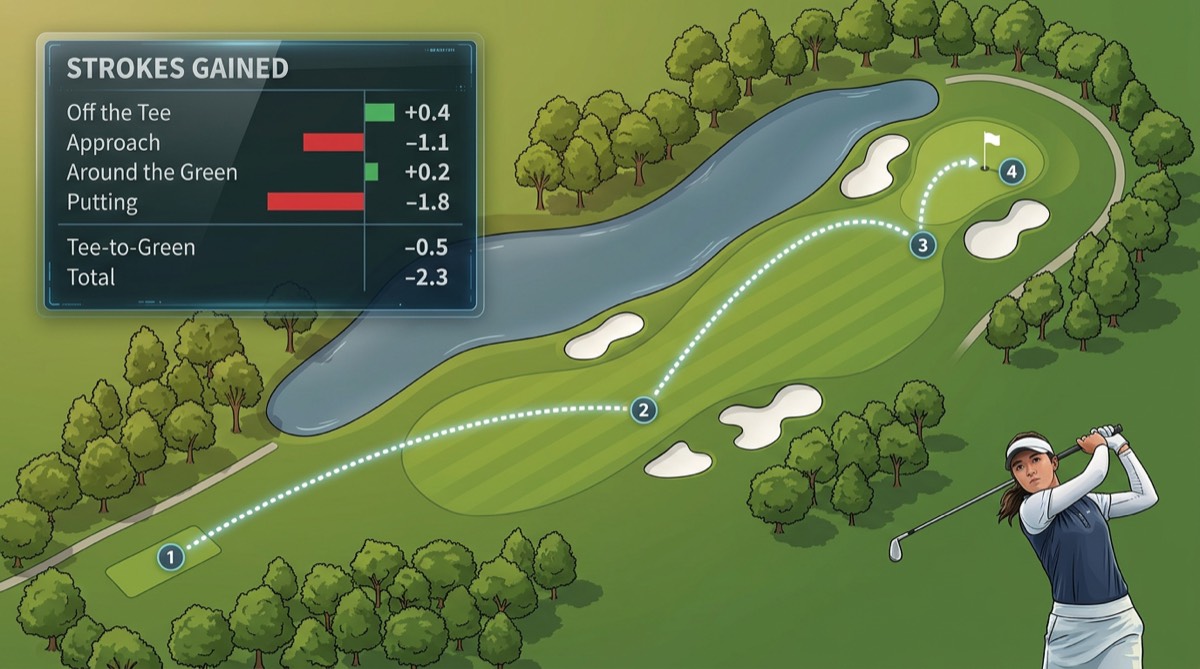
That distance-lie-result trio is also the exact raw material that Strokes Gained runs on — comparing every shot to what a benchmark player would do from that same spot. You can't compute it from "5." You can compute it from a card that knows the 5 was a 405-yard par 4 played drive-right, approach-from-rough-long, chip-to-five-feet, missed-putt, tap-in.
A standard scorecard remembers the number. This one remembers the round the number came from.
3. A walk through what the card captures
Every field on the card exists to answer one question — where did this shot start, and how did it finish — so let me walk a hole in order.
The tee shot logs the club used, where the ball finished (left, middle, or right), and driving accuracy — how many yards offline it ended up. That turns "missed the fairway" into "missed right by 16 yards with driver," which is a completely different note for your junior than a vague checkbox.
The approach records distance to the pin, the lie it was played from (fairway, rough, sand, or recovery), and where it finished. The card has room for two approach shots, plus a counter for the rare hole that needs more. This is the mid-range approach that so often decides birdie-or-bogey, captured with its starting distance and lie — so you can tell the difference between a kid who's bad from 170 and a kid who's only bad from 170 out of the rough.
The short game is where the card gets detailed, because the short game is where rounds are saved or lost. Each chip or pitch logs distance, lie, trajectory (low runner, mid, or high), and the result in two dimensions — depth (over, pin-high, or short) and width (left, middle, or right). A missed chip stops being "chip" and becomes "from rough, high, finished pin-high but four feet right," which tells you whether the miss was contact, club selection, or aim.
Penalties are tracked in two separate fields — OB/lost balls in one, hazards in the other — and each records not a count but the stroke sequence of which shots resulted in the penalty. A tee shot that goes OB twice is logged as "13" — meaning shots 1 and 3 both went OB. That tells you not just how many penalties happened, but where in the hole they came from, which matters when you analyze decision-making.
Putting captures GIR, the first putt's starting position relative to the hole (front, behind, or pin-high), and then, for each putt: distance in feet, the slope (uphill, downhill, or none), the break, and which way a miss went (low, high, or short). That's what turns a three-putt into a diagnosis — a lag-distance problem from long range reads completely differently from a series of short putts missed on the low side.
The hole closes with any remaining penalties and the score. Nothing on the card is decoration. Every box is there because Strokes Gained — or you, reading the round back later — needs it.
4. What it gives you back
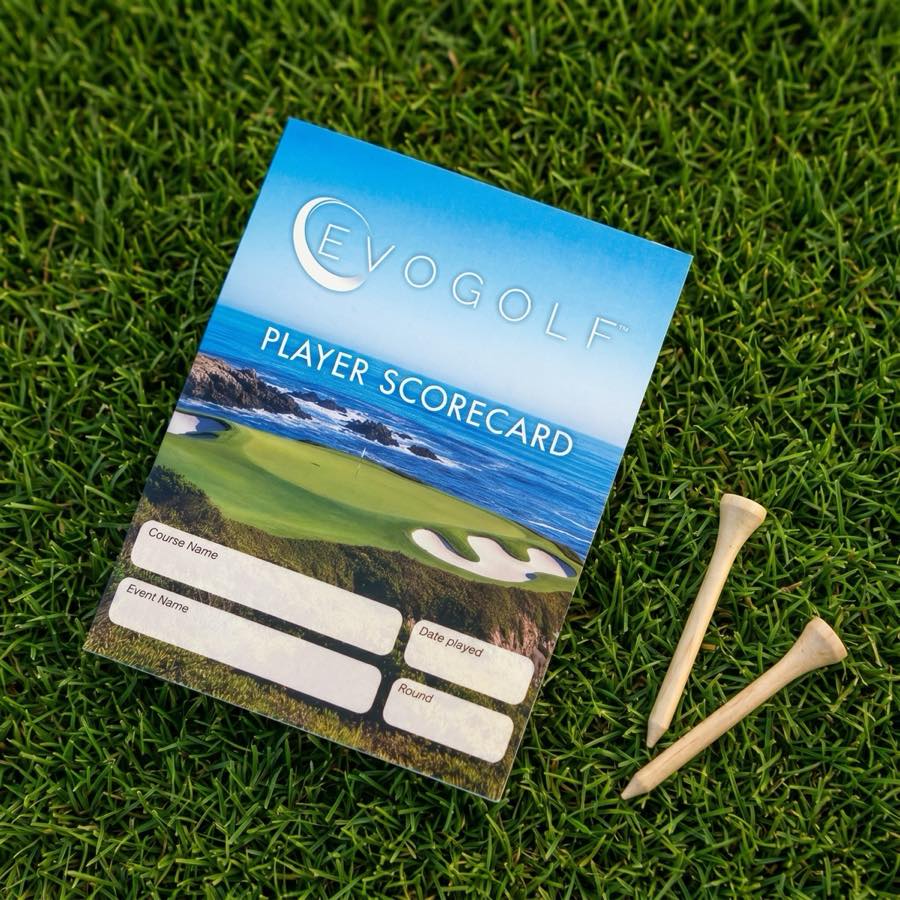
A completed card is raw data — accurate, but still just ink on paper. The point is what it becomes: feed the round into EvoGolf and it turns into a per-shot, per-category Strokes Gained profile — your junior's gains and losses off the tee, on approach, around the green, and on the greens, with the biggest leaks ranked so you know what to work on first. All of it lives in a dashboard built to be read at a glance, not deciphered. (You can get the card itself at shop.evogolf.ai; the step-by-step of capturing and uploading one is its own short guide: How to Use the EvoGolf Scorecard.)
And here's the part that matters most for parents who don't think of themselves as "analytics people" — and that's most of us. You don't have to know what any of these metrics mean. EvoGolf includes a narrative analysis written by ShotIQ™ — the AI analyst built into the platform — that explains what the round shows, in plain English. What's going well. What's costing strokes. What's worth working on this week, and why. The numbers are there for the parents who want them. The story is there for everyone else.
And if there's something in the analysis you want to dig further into — a metric you want explained, a pattern you noticed, a question the report didn't quite answer — you can ask ShotIQ™ directly in live chat, the way you'd ask a coach. Most parents don't have a coach available at 9pm on a Sunday going through yesterday's round. ShotIQ™ is the version that is.
I'll tell you what this replaces. This used to take me hours after every round — a spreadsheet, a stack of notes, a calculator, trying to back-engineer something that looked like a Strokes Gained breakdown so I'd know what to tell my kid to practice on Monday. The whole point of building EvoGolf was to take those hours back, and make the answer available to any parent who wants it — not just the one willing to do it the hard way.
That's the whole reason I built it. You're already keeping score — every junior family is. This just captures the round the score came from, so that instead of a number you can't explain, you end up with a profile, a dashboard, and an analyst — together — that tell you exactly why your junior's game is where it is and precisely what to fix next. The work you're already putting in finally becomes something you can see.
A standard scorecard was never going to show you that. It was built to settle a bet, not to develop a player. This one was built the other way around.
Because every stroke counts.
© 2026 EvoGolf. All rights reserved.