When my younger junior's scores stalled, I did what I think most golf parents do on reflex: I booked more lessons. It felt like the responsible move — the proactive, invested-parent move. If the game isn't improving, get more coaching. More inputs, better outputs. That's how it works with almost everything else we pour money into for our kids.
Six weeks of lessons later, the tournament scores hadn't budged. The swing looked better on video. The scores did not care how the swing looked on video.
That stretch taught me something I'd had backwards: lessons, tournament rounds, and casual play aren't three amounts of the same thing. They're three different things, each building a different capacity, and the reason my money wasn't working was that I kept buying more of the one my kid already had plenty of. If you're staring at the calendar and the credit-card statement trying to figure out where the next hour should go, let me walk you through what each bucket actually does.
1. The three time-buckets and what each builds
Think of your junior's golf time as falling into three buckets, because each one develops a genuinely different muscle.
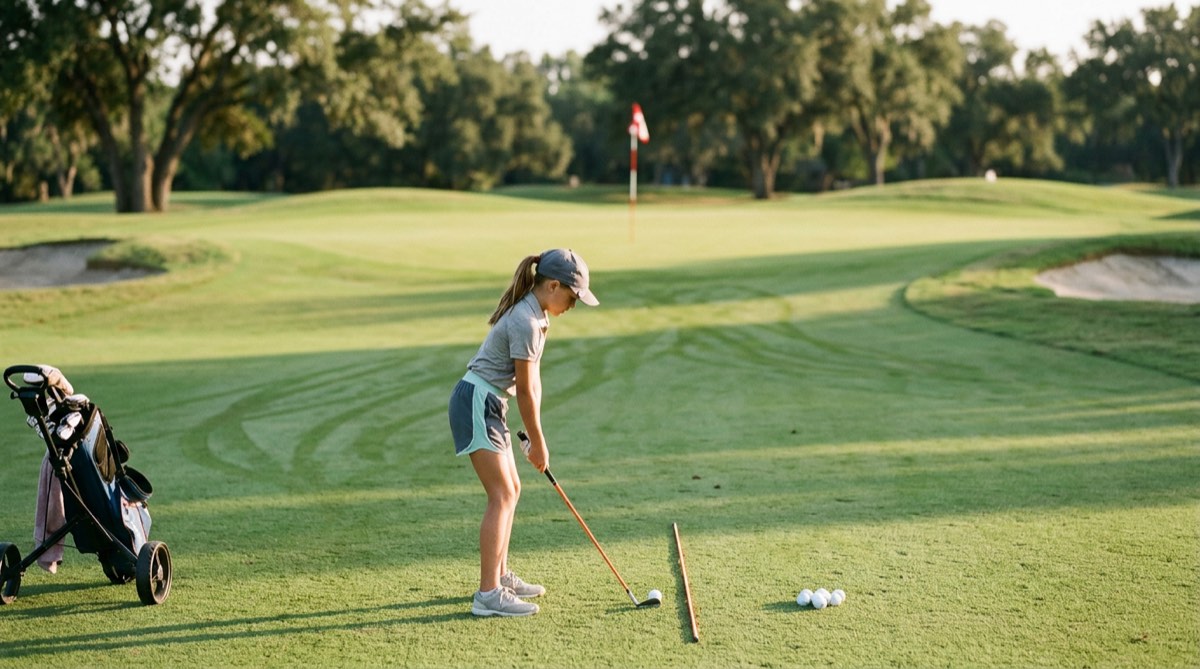
Lessons build mechanics. This is the controlled environment — a coach, a specific movement, often a launch monitor, immediate feedback, the same shot repeated until the pattern changes. Lessons are where you fix how the body moves. They're essential when there's an actual technical fault: a grip that's costing a slice, a sequence that's leaking power, a setup that sends every wedge long.
Tournament rounds build pressure tolerance — and they generate the truest data. A tournament is the only place your junior hits shots that count, with nerves, on a course set up to test them, against a real field. It builds the skill of scoring when it's uncomfortable, which is a separate skill from hitting good shots when it's comfortable. Plenty of juniors have a beautiful range swing that evaporates on the first tee, and no lesson fixes that — only reps under real stakes do.
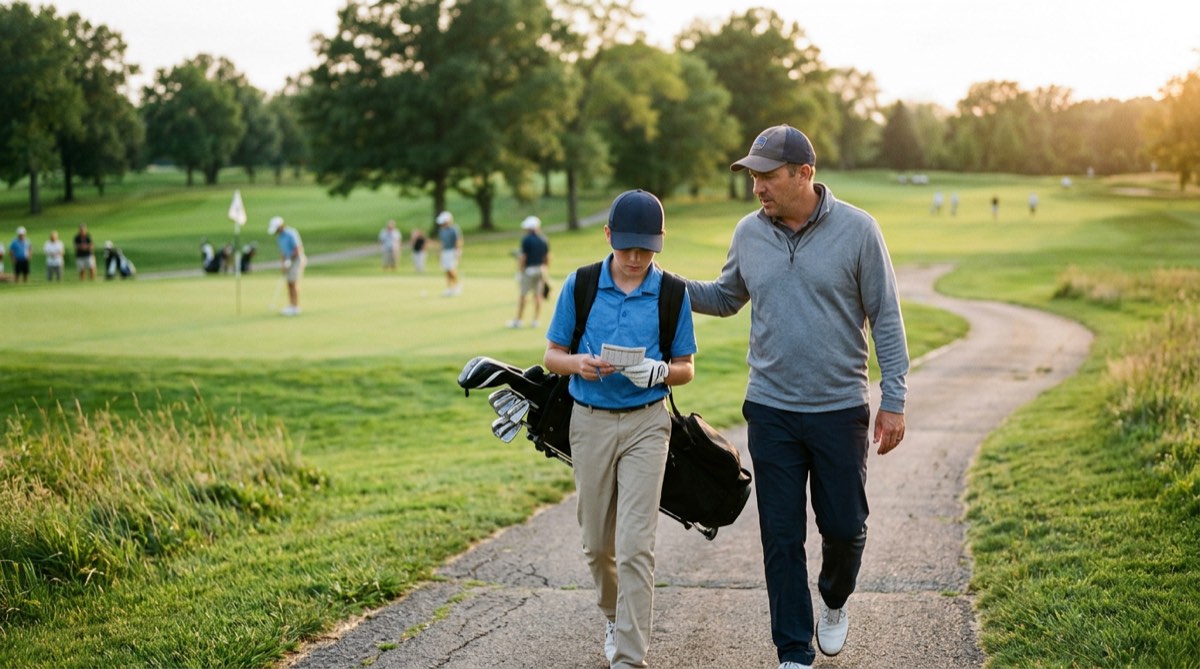
Casual play builds course management and adaptability. Unstructured rounds — with friends, with you, alone in the evening — are where a kid learns to navigate a hole, recover from a bad spot, choose between aggressive and safe, and string fourteen clubs into a round without a coach narrating. It's the least glamorous bucket and, I'd argue, the most underrated.
Three buckets, three different muscles. The mistake — my mistake — is treating them as interchangeable and just buying more of whichever feels most productive.
And "most productive" almost always means lessons, because lessons are the only bucket that comes with a receipt and an expert telling you something specific got better. Tournaments come with a finish, which is noisy. Casual rounds come with nothing you can point to. So the bucket that's easiest to feel good about funding wins by default, regardless of whether it's the bucket your kid actually needs. That's the bias worth naming, because once you see it, you stop letting it drive the calendar.
2. The "more lessons" reflex — and when it backfires
The more-lessons reflex is so natural that it's almost invisible. Scores stall, anxiety rises, and a lesson is the one thing you can do — book it, pay for it, feel like you've responded. It converts helpless worry into action. I get the pull completely; I lived it. And it's not a cheap reflex — a mid-tier coach runs about $200 an hour, top-tier averages $350, and a few top-end names ask $1,000 — so the default move can burn real money long before anyone confirms it's the right fix.
Here's when it backfires. Lessons fix mechanics, so they only help if mechanics are the actual problem. If your junior's leak is really three-putting, or coming undone on the back nine when they're in contention, or playing every par 5 like a hero and making bogey, then more swing lessons are pouring water on a part of the garden that isn't dry. The swing gets prettier. The scores don't move, because the scores were never about the swing.
I'm not anti-lesson. A good coach is one of the best investments in junior golf, and I'd never tell a parent otherwise. I'm anti-default — anti reaching for the same tool every time, regardless of what the problem actually is. The question is never "should we take lessons." It's "what is this specific kid losing strokes to, and is a lesson the thing that fixes it?" Most of the time we never ask, because we can't see the leak clearly enough to know.
So here's the rule I wish I'd had: get lessons after the data, not before it. Measure where your junior is actually losing strokes, then watch those gaps over a stretch of rounds — casual ones included. The ones that close on their own, just from playing more, were never a lesson. But a gap the data keeps flagging that doesn't improve even during relaxed casual play is usually a real mechanical fault — exactly what a good coach fixes. That's when you book the lesson, and you walk in knowing precisely what it's for.
3. Tournament rounds as data, not just experience
When a game stalls, the tournament version of the more-lessons reflex kicks in: just enter more events. More reps, more chances — surely one of them breaks the slump. But piling on tournaments hoping a good result falls out is a lot like feeding a slot machine: you keep paying for pulls, you get the occasional hit that keeps you feeding it, and the machine itself never changes. A stalled game doesn't need more pulls. It needs someone to look at why the rounds keep coming out the way they do.
And the irony is that the answer is sitting right there. We treat tournaments as outcomes — the finish, the trophy, the ranking — but the round you already paid an entry fee for is the richest data you'll get all month, and most families throw it away the moment the scorecard's signed.
A tournament round is your junior's game under real conditions: real nerves, real course setup, real consequences. The patterns that show up there are the patterns that actually decide their golf — far more honest than anything that shows up on a calm practice round. If your kid loses a stroke and a half a round on approach shots in tournaments but not in practice, that gap is the lesson. It's telling you the problem is pressure-sensitive, which points you somewhere a swing change never would.
The shift that changed things for our family was starting to treat every tournament round as a deposit into a record, not just a result to feel good or bad about. Over a handful of events, the patterns stopped being anecdotes — "he always seems to struggle on the closing holes" — and became something I could actually see and verify. That's the difference between experience and data: experience is the story you tell from memory, and memory edits — it keeps the dramatic moments and quietly drops the rest. Data is the round, kept. I wrote more about turning rounds into a real picture in How to Build a Performance Profile for Your Junior Golfer.
4. Casual play: the most underrated layer
If I could go back and rebalance my kids' early golf years, I'd add casual rounds and subtract lessons. Not eliminate lessons — rebalance.
Unstructured play is where a junior actually learns to play golf as opposed to hit golf shots. On the range, every shot is the same shot from the same lie with the same club and no consequence. On the course, alone or with friends, your kid faces a downhill lie in the rough with a tree in the way and has to invent something — and inventing something is a skill the range can't teach because the range never asks the question.
Casual play also builds the relationship with the game, which matters more than we admit. Junior golf is expensive and exhausting and emotional, and a kid who only ever experiences golf as lessons-and-tournaments — as work and as judgment — is a kid at real risk of burning out. The evening nine with no one watching and no score that counts is often where the love survives. And the love is the engine for everything else. A kid who quits at 15 has a perfect swing and no golf career.
The reason casual play gets cut first is that it's the hardest bucket to feel good about spending money on — there's no coach, no trophy, no obvious progress. But "no obvious progress" isn't the same as "no progress." It's just progress you can't see without looking underneath the score.
There's also a sneaky benefit most families miss: casual rounds are a low-stakes lab. When your junior tries what they worked on in a lesson, the casual round is where they find out whether it survives contact with an actual hole — a real lie, a real number, a real decision — with no result riding on it. If the new wedge technique holds up over an evening nine, it's ready for a tournament. If it falls apart at the first tree, better to learn that on a Tuesday than on Saturday with a ranking on the line.
5. A data-led time allocation (with a concrete weekly example)
So where does the hour go? The honest answer is: it depends on what your specific junior is losing strokes to — which is exactly why seeing the leak clearly is the unlock. But let me give you a concrete starting framework for an intermediate competitive junior, say 13 to 16, in season.
An hour spent on mechanics your kid has already mastered isn't practice — it's a very expensive way to feel productive.
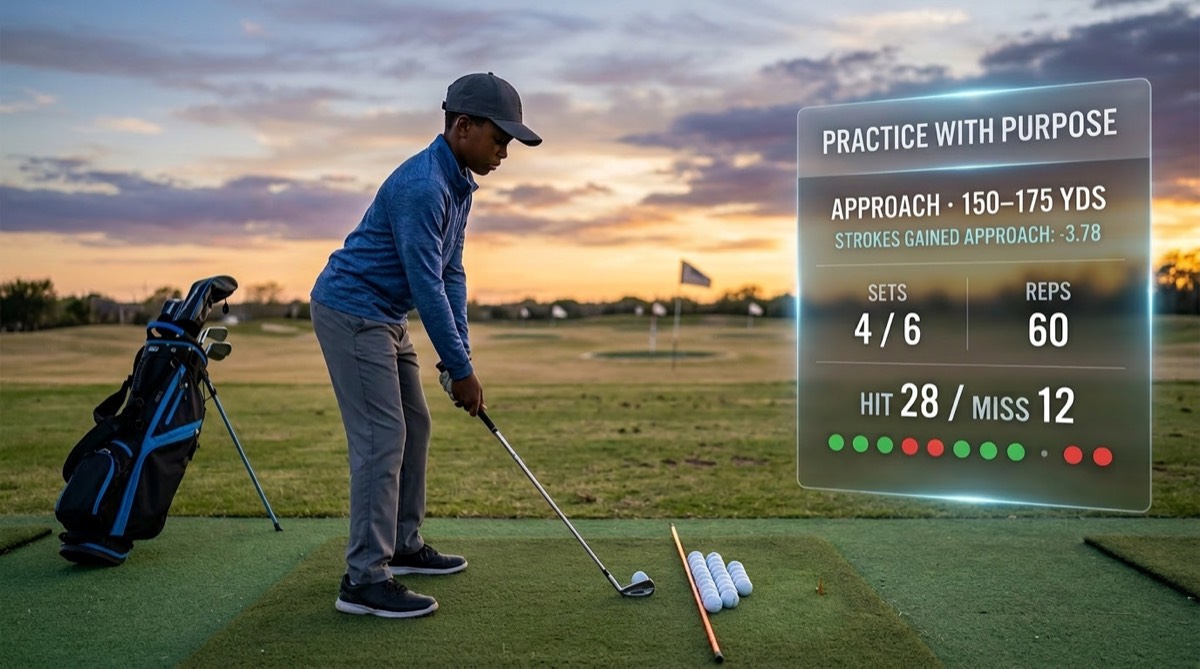
A reasonable in-season week might look like one lesson (roughly an hour, mechanics — but only if there's a real technical leak to work on), three to four hours of purposeful practice built around that leak rather than aimless ball-beating, one tournament or competitive round, and one or two casual rounds for course management and, frankly, for joy. That's a balance, not a prescription — and the word doing the heavy lifting is purposeful. Range time built around the actual leak is worth several times the same hours spent hitting drivers because drivers are fun. I broke down what purposeful actually looks like in From "Just Hit Balls" to Purposeful Practice.
Now flip the framework. If your junior's data says the leak is putting from 6 to 10 feet — where a kid can give back close to two strokes a round — that one lesson should be a putting lesson, the practice hours go to a putting drill, and the casual rounds become a place to test it under mild stakes. If the data says mid-range approach shots from 140 to 170 yards, the whole week tilts toward irons. The allocation isn't fixed — it follows the leak. That's the entire point.
Here's the test I use now before committing an hour: can I name the capacity it's meant to build and the leak it's meant to close? If the answer is "more lessons because the scores are stuck," that's a reflex, not a plan. A plan starts with knowing what's actually leaking — then you point the buckets at the right target instead of the comfortable one.
Which brings me back to those six weeks of lessons that did nothing. They didn't fail because lessons are bad. They failed because I was spending by reflex instead of by evidence — buying mechanics for a kid whose problem wasn't mechanics. Junior golf is expensive enough without paying for the wrong fix. The goal was never to spend less; it's to spend only on what this kid's game actually needs — pointing the next hour, and the next dollar, straight at the leak.
Because every stroke counts.
© 2026 EvoGolf. All rights reserved.